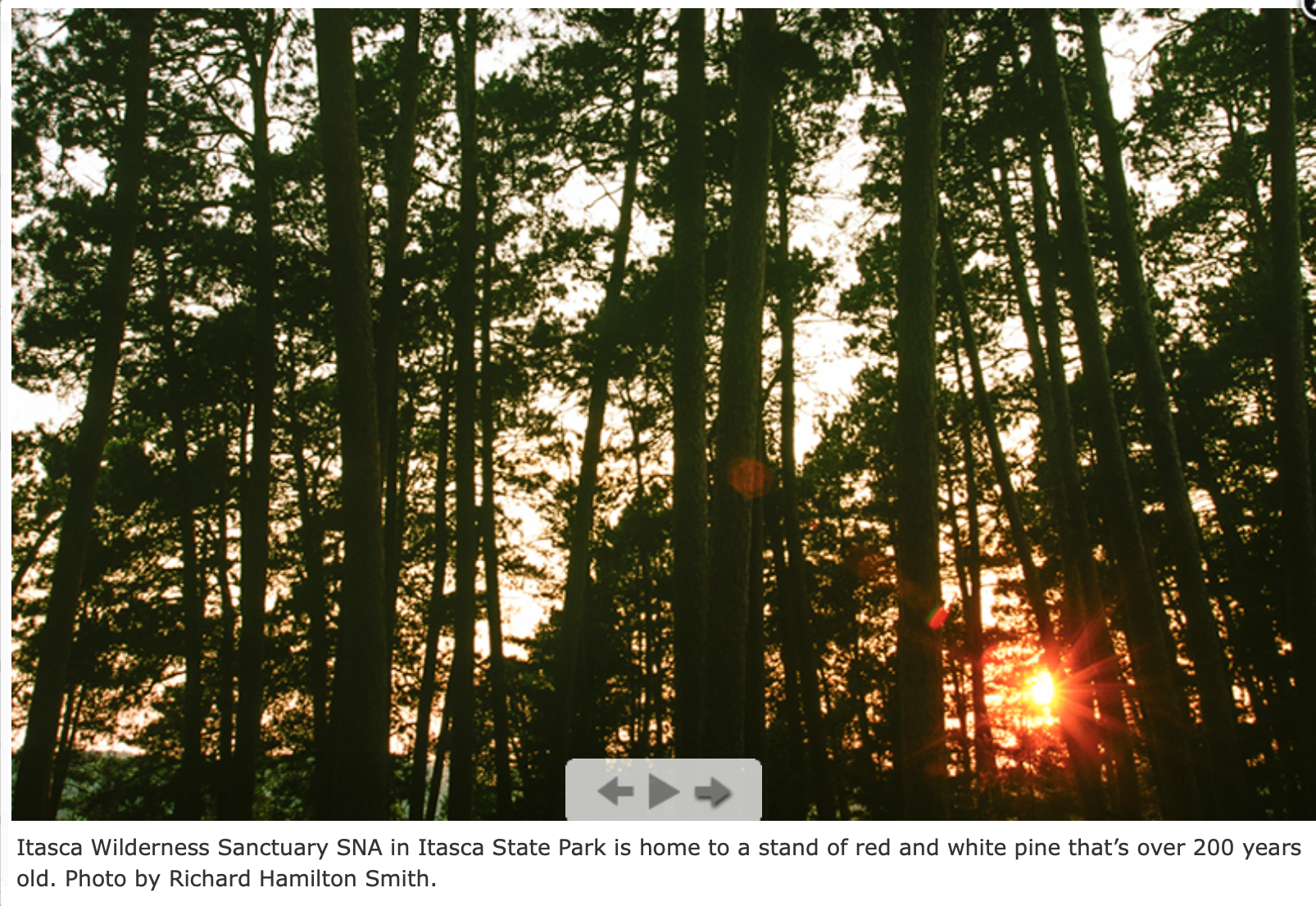
When this story came out in January, it was quickly superseded by events on the ground in Minnesota. All the sudden, it didn’t seem very important.
But I know that’s not true. This story is important. It reaches far beyond the current news cycle, the current year, and even the current century.
The Old Growth Forest Network is a great resource. If you’d like to step outside of our current moment, into deeper time, check out my story on the Old Growth Forest Network to find out where and how:
On a sunny fall afternoon, I drive west from Minneapolis, past the strip malls and cul-de-sacs, until I come to a church parking lot. Tucked into the back corner are a few wooden benches and a brown sign with the telltale yellow lettering: “Wolsfeld Woods Scientific and Natural Area.”
A small dirt trail leads up into the trees. As I climb through the opening, the modern world recedes behind me and another one opens.
Wolsfeld Woods is one of the few remaining patches of “Big Woods” left in Minnesota. These maple-basswood forests once covered 1.3 million acres between the Mississippi and Minnesota rivers. Most of that is gone now, but thanks to the Wolsfeld family’s syrup business, this 165-acre patch was spared.
In 1978, Wolsfeld Woods became one of Minnesota’s first Scientific and Natural Areas, and in 2024 it became one of Minnesota’s first forests inducted into the Old Growth Forest Network, a national organization that raises awareness about the last parcels of ancient forest left standing across America.
“We’re working around the country to identify the best example of the oldest forest in every county,” says Nick Sanchez, manager of the network. “We see them as a gateway to pull people into caring about the environment and conservation. These are some of the most inspiring places you can visit.”
Read the rest here: New Focus on Old Growth: Minnesota now has eight nationally recognized old growth forests, all on DNR lands. More may be on the way.
 Frank Bures
You must be logged in to post a comment.